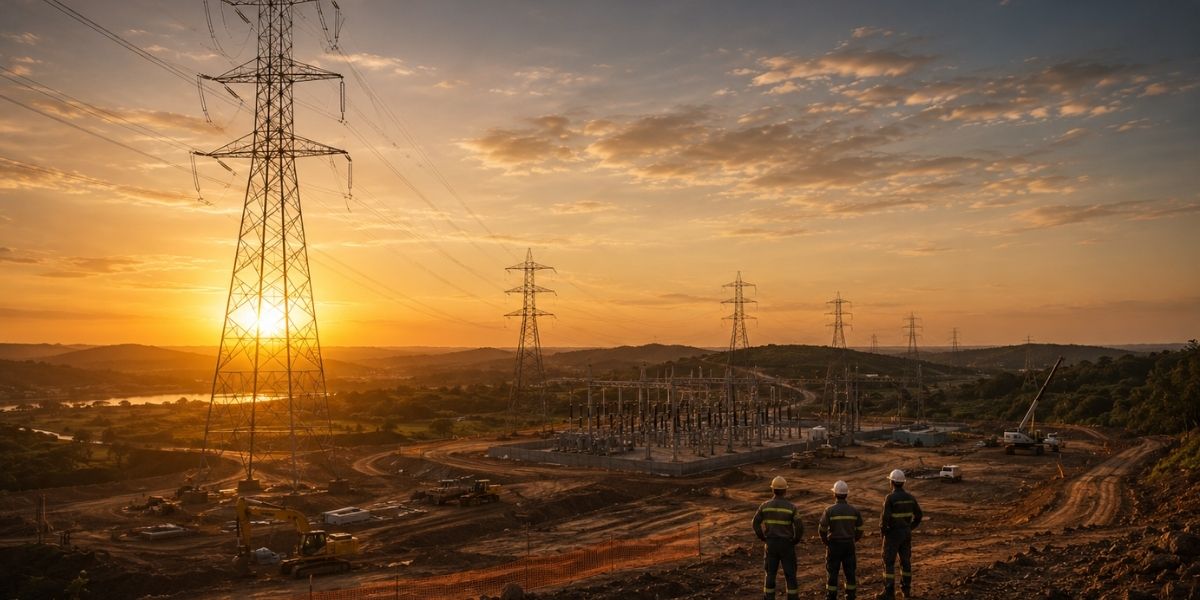
In recent years, the power sector has undergone transformations that have redefined how we view electrical quantities within substations. New technologies are emerging in the market, proving their efficiency and cost-benefit ratio, while simultaneously driving the modernization of these facilities. Hardware and software are being developed for applications that, until recently, seemed unlikely and are now part of the reality of executive projects.
The digitalization of substations is not just about adopting new equipment or protocols. The most profound change lies in the architecture. It is in the way information is born, circulates, and supports decisions in a critical environment that has no margin for error.
For decades, substation design was structured around analog signals, extensive secondary cabling networks, and point-to-point integrations. This model served its purpose for a long time, but it began to reveal limitations as the electrical system became more complex, more distributed, and more demanding in terms of reliability. The transition to digital environments emerged precisely in this context, driven by the need for greater operational efficiency, performance predictability, and expansion capacity.
With the consolidation of IEC 61850, the substation is no longer perceived as a set of isolated systems and is now conceived as an integrated data environment. Protection, control, and supervision began to share the same communication infrastructure, each with its own requirements for timing, priority, and availability. This movement brought clear gains in standardization, increased interoperability between different manufacturers, and paved the way for a more strategic approach to the asset life cycle.
In this context, the process bus represents a structural breakthrough. Replacing the extensive copper cable runs used for measuring analog electrical quantities and equipment supervision with digital communication over fiber optic networks redefines the engineering of these facilities. Currents and voltages no longer physically travel to the panels; instead, they are digitized and transmitted as structured, synchronized, and prioritized data within the network. The impact goes beyond simple cabling reduction: it increases expansion flexibility, standardizes interfaces, and establishes a new logic of reliability based on communication architecture.
Reliability is no longer restricted to physical robustness and now also depends on network resilience. Redundant topologies ensure availability even in the face of failures, while time synchronization increases the precision of analyses. Protection remains fast, now supported by a consistent and traceable data environment.
In Brazil, this evolution is occurring gradually, keeping pace with technical and regulatory challenges. The integration of renewables, the search for higher systemic performance, and the pressure for efficiency make it clear: digital substations are no longer a trend; they are a reality.
At BR INFRA, we understand this transformation as an essential part of the infrastructure that will support the country’s next growth cycles in the sector.